
REDUCE WILDFIRE RISK BEFORE IT REACHES YOUR DOOR
Prepare Your Home for Wildfire
Preparing your home for wildfire begins with understanding where and how ignition can occur. By reducing vulnerable conditions on the structure and throughout the surrounding property, homeowners can limit exposure to embers, direct flames, and radiant heat and create a more defensible home. The Home Ignition Zone provides a practical framework for understanding these risks and the actions homeowners can take from the structure outward.
What Is the Home Ignition Zone?
The Home Ignition Zone includes the home and its immediate surroundings, where the condition of the structure, vegetation, and other combustible materials can influence whether a home ignites during a wildfire.
This area encompasses the building itself, nearby landscaping and vegetation, fencing, decks, outbuildings, stored materials, and other combustible features that may expose the home to embers, direct flames, or radiant heat.
The Home Ignition Zone generally extends from the structure outward to 100 feet or the property line, whichever comes first. It is divided into three zones, with the greatest level of protection focused on the area closest to the home.

ZONE 0: 0 TO 5 FEET | EMBER-RESISTANT ZONE
Zone 0 extends five feet outward from the exterior wall, roof edge, or outer edge of an attached deck, stairway, or pergola. It ends at five feet or at the property line, whichever comes first. Self-supporting decks, stairways, and pergolas located within one foot of the structure are considered attached features.
Research and wildfire experience show that this is the most critical area for reducing the risk of home ignition because windblown embers can ignite combustible materials next to the structure. Begin with the home itself, then address the landscaping, stored items, and other materials within the first five feet.
Zone 0 Requirements
-
Keep roofs and rain gutters free of leaves, pine needles, and other combustible debris.
-
Remove combustible mulch, wood chips, fallen leaves, pine needles, and other combustible debris from Zone 0, except where specifically permitted under the regulations.
-
Do not store firewood within five feet of the structure.
-
Keep the areas beneath decks, balconies, stairways, and pergolas free of vegetation, furniture, lumber, cardboard, stored materials, and other combustible items.
-
Use noncombustible surfaces such as gravel, rock, pavers, or concrete in required vegetation-free areas.
-
Review the detailed Zone 0 vegetation requirements before removing established plants or trees. Limited, well-maintained non-woody vegetation may be permitted in qualifying portions of the zone.
Recommended Home-Hardening Actions
The following improvements can help the structure resist ember intrusion and ignition. These are valuable wildfire-safety measures, but not all are requirements established by the August 2026 Zone 0 regulation:
-
Repair loose, damaged, or missing shingles and roof tiles, and seal gaps that could allow embers to enter the roof assembly.
-
Keep attic, crawlspace, and eave vents free of debris.
-
Replace vulnerable vents with California State Fire Marshal-listed flame- and ember-resistant vents when possible.
-
Where permitted under local building and ventilation requirements, cover vulnerable vent openings with noncombustible, corrosion-resistant metal mesh with openings between 1/16 inch and 1/8 inch.
-
Repair damaged window screens and broken windows. When replacing vulnerable window screens, use metal mesh.
-
Regularly remove debris from the surface and underside of decks.
-
Consider enclosing the base of a deck with appropriate metal screening to help prevent embers and debris from accumulating beneath it. The Board identifies this measure as a best practice, not a Zone 0 requirement.
ZONE 1: 5 TO 30 FEET | LEAN, CLEAN & GREEN
Zone 1 begins at the outer edge of Zone 0 and extends to 30 feet from the structure or attached deck, or to the property line, whichever comes first.
Landscaping and hardscaping in this zone should be carefully planned and maintained to reduce available fuel, interrupt pathways for fire, and help prevent flames from spreading into tree canopies or toward the home.
Zone 1 Requirements and Maintenance Standards
-
Remove dead and dying grass, plants, shrubs, trees, branches, leaves, pine needles, and other combustible debris.
-
Keep tree branches at least 10 feet from chimneys and stovepipe outlets.
-
Keep the areas beneath decks, balconies, and stairways free of flammable vegetation and combustible items.
-
Maintain adequate horizontal and vertical separation among grasses, shrubs, and trees.
-
Remove ladder fuels that could allow a surface fire to spread into shrubs or tree canopies.
-
Maintain at least 10 feet of clearance around propane tanks and outbuildings, keeping the area free of flammable vegetation and combustible materials.
Recommended Fuel-Reduction Practices
-
Use driveways, walkways, paths, patios, and other noncombustible surfaces to create breaks in continuous vegetation.
-
Prune lower tree branches to create vertical separation from grasses and shrubs. When pruning shorter trees, avoid removing more than the lowest one-third of the tree’s height.
-
Arrange shrubs and trees in small, separated groupings rather than continuous rows or dense masses.
-
Increase the space between plants on sloped properties because fire generally moves faster and burns more intensely uphill.
-
Plan new tree and shrub placement according to the plants’ mature size so that branches and canopies will not contact the structure or create continuous pathways for fire.
-
Keep grasses properly maintained, free of accumulated dead material, and within the maximum height permitted by Los Angeles County.
Local Requirements Apply
Zone 1 and Zone 2 requirements in Local Responsibility Areas may be established or supplemented by the local fire authority. Acton property owners should follow current Los Angeles County Fire Department vegetation-management and brush-clearance requirements.
ZONE 2: 30 TO 100 FEET | REDUCED FUEL ZONE
Zone 2 extends from 30 to 100 feet from the structure or attached deck, or to the property line, whichever comes first.
In Los Angeles County, additional vegetation clearance beyond 100 feet, up to a maximum of 200 feet, may be required because of a structure’s location or other hazardous conditions.
Landscaping in this zone is not intended to eliminate every plant or prevent fire from entering the property. It should be maintained to reduce available fuel, interrupt the fire’s path, and help keep flames smaller and closer to the ground.
Zone 2 Requirements and Maintenance Standards
-
Remove heavy accumulations of leaves, pine needles, branches, and other combustible ground litter.
-
Remove dead and dying plants, shrubs, trees, and branches.
-
Cut or mow grasses to the maximum height required by the local fire authority.
-
Create adequate horizontal spacing among shrubs and trees.
-
Prune lower tree branches and remove ladder fuels that could allow a surface fire to spread into tree canopies.
-
Remove or reduce vegetation next to storage sheds and other outbuildings.
-
Maintain at least 10 feet of clearance around propane tanks and outbuildings, keeping the area free of flammable vegetation and combustible materials.
Recommended Fuel-Reduction Practices
-
Break up continuous areas of vegetation by separating shrubs, trees, and other plant groupings.
-
Remove small trees or conifers growing beneath or between mature trees when they create ladder fuels or connect tree canopies.
-
Increase spacing between plants and tree canopies on steeper slopes, where fire can travel faster and burn more intensely.
-
Maintain trees and shrubs as separated individuals or small groupings rather than as a continuous wall of vegetation.
-
Retain healthy, properly spaced vegetation when it does not create a pathway for fire.
Plant and Tree Spacing
Required spacing depends on the type and size of the vegetation, the steepness of the slope, and other site-specific conditions. Larger plants and vegetation on steeper slopes generally require greater separation. Consult the Los Angeles County Fire Department or a qualified forestry professional when site conditions make the appropriate spacing unclear.
PRACTICAL GUIDANCE
Practical Ways to Prepare Your Home for Wildfire
Defensible space involves more than clearing vegetation close to your home. Trees, firewood, propane tanks, and other features must also be properly maintained and separated to reduce potential pathways for fire.
Use these practical guides to review three conditions commonly found on Acton properties.


WILDFIRE EXPOSURE
How Wildfire Can Reach Your Home
A home can be exposed to wildfire in three primary ways: wind-driven embers, direct flames, and radiant heat.
Understanding these exposures can help you identify and correct vulnerable conditions around your home.
EMBERS
Wind-driven embers are a leading cause of home ignition during wildfires. They can travel far ahead of the main fire and enter small openings or ignite combustible materials on and around a structure.
-
Embers can enter through vents, gaps, roof edges, eaves, and other small openings.
-
They can collect in gutters, roof valleys, decks, porches, and spaces beneath structures.
-
Leaves, pine needles, mulch, outdoor furniture, wood fencing, and stored materials can ignite from embers.
-
Sheds and other outbuildings can ignite and expose the home to additional flames and embers.
-
Embers can remain hot, create spot fires, and cause ignition even when flames are not nearby.
DIRECT FLAMES
Direct-flame exposure occurs when flames come into contact with the home or another combustible feature connected to it.
-
A small fire started by an ember can grow and spread to the structure.
-
Continuous vegetation can create a pathway for flames to travel toward the home.
-
Wood fences, gates, decks, stairs, and pergolas can carry fire directly to the structure.
-
Outdoor furniture, firewood, lumber, and other combustible items can expose walls, windows, eaves, and decks to flames.
-
Nearby sheds, vehicles, and neighboring structures can also create direct-flame exposure.
RADIANT HEAT
Radiant heat can damage or ignite building materials without direct flame contact. The risk increases when a large fire burns intensely or close to the structure.
-
Burning vegetation, woodpiles, sheds, vehicles, and neighboring homes can produce intense radiant heat.
-
Radiant heat becomes more dangerous as the size and duration of the fire increase and its distance from the home decreases.
-
Heat can preheat exterior materials, making them easier to ignite.
-
Windows may crack or fail, allowing embers and flames to enter the home.
-
Prolonged heat exposure can weaken siding, doors, decks, and other building materials.
Reducing combustible materials, separating vegetation, and strengthening vulnerable parts of the home can help limit exposure to embers, direct flames, and radiant heat.


EMBERS sUMMARY
Wind-driven embers are a major cause of home ignition during wildfires. They can travel far ahead of the main fire and ignite vulnerable materials on, inside, or around a home.
-
Embers can enter through vents, gaps, eaves, roof edges, and other small openings.
-
They can collect in gutters, roof valleys, decks, porches, and spaces beneath structures.
-
Embers can ignite leaves, pine needles, mulch, outdoor furniture, wood fencing, and stored materials.
-
Burning sheds and other outbuildings can expose the home to additional flames and embers.
-
Embers may remain hot and cause spot fires even when flames are not nearby.

DIRECT FLAMES SUMMARY
Direct-flame exposure occurs when flames touch the home or another combustible feature connected to it.
-
A small fire started by an ember can grow and spread to the structure.
-
Continuous vegetation can create a pathway for flames to travel toward the home.
-
Wood fences, gates, decks, stairs, and pergolas can carry fire directly to the structure.
-
Outdoor furniture, firewood, lumber, and other combustible items can expose the home to flames.
-
Burning sheds, vehicles, and neighboring structures can also create direct-flame exposure.

RADIANT HEAT SUMMARY
Radiant heat can damage or ignite building materials without direct contact from flames. The risk increases when a large fire burns intensely or close to the home.
-
Burning vegetation, woodpiles, sheds, vehicles, and neighboring homes can produce intense radiant heat.
-
Radiant heat becomes more dangerous as the size and duration of the fire increase and its distance from the home decreases.
-
Heat can preheat exterior materials, making them easier to ignite.
-
Windows may crack or fail, allowing embers and flames to enter.
-
Prolonged heat exposure can weaken siding, doors, decks, and other building materials.
Reducing combustible materials, separating vegetation, and strengthening vulnerable parts of the home can help limit exposure to embers, direct flames, and radiant heat.
DEFENSIBLE SPACE
California’s New Zone 0 Regulations
CALIFORNIA ZONE 0 UPDATE
On August 19, 2026, the California Board of Forestry and Fire Protection approved proposed emergency regulations for Zone 0. The regulations establish new requirements for the first five feet around structures, with phased compliance for existing properties. Requirements and implementation dates may change. Consult CAL FIRE, the Board of Forestry and Fire Protection, and the Los Angeles County Fire Department for current requirements.
What Is Zone 0?
Zone 0 is the area extending from a structure outward five feet, or to the property line, whichever comes first. It begins at the exterior surface of the wall, roof edge, attached deck, stairs, or pergola.
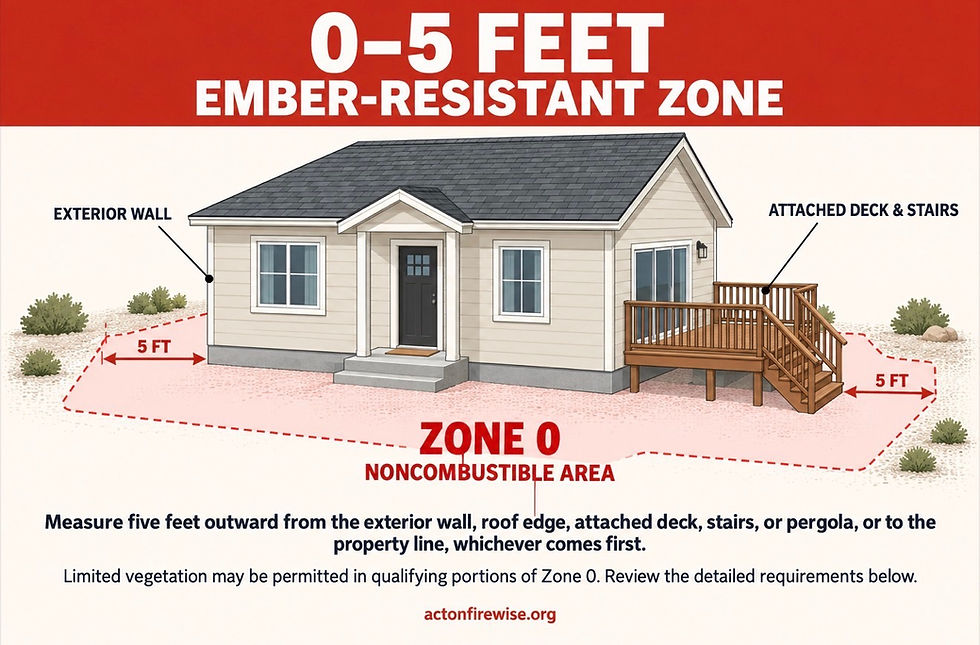
What Should Be Addressed in Zone 0?
Start with the conditions most likely to ignite and carry fire to the structure.

This graphic provides a general overview. Review the detailed requirements below for vegetation allowances, required clearances, fencing standards, and the phased compliance schedule.

Track Your Firewise Hours in Minutes

Wildfire-Prevention Work Helps Our Community Stay Firewise
There is no fee to participate in a Firewise community.
To earn and maintain Firewise USA® recognition, the community must collectively document wildfire-risk-reduction work each year. NFPA requires each recognized site to report an annual investment equal to at least one volunteer hour for every home within the site.
For example, a community with 100 homes must collectively document the equivalent of at least 100 volunteer hours. This total can come from the combined work and qualifying expenses reported by residents, the HOA, community volunteers, and local partners. Individual households are not required to complete one hour or pay a fee.
What can be reported?
Work around your home
-
Cleaning leaves and pine needles from roofs and gutters
-
Clearing debris from beneath decks and porches
-
Mowing grass and weeds
-
Trimming trees and shrubs
-
Removing dead or hazardous vegetation
-
Creating and maintaining defensible space
-
Replacing combustible mulch with rock or gravel
-
Moving firewood and other combustible materials away from structures
Home-hardening improvements
-
Installing metal screening or ember-resistant vents
-
Repairing roofing, siding, eaves, soffits, or windows
-
Replacing combustible fencing attached to the home
-
Installing metal gutters
-
Improving decks and areas beneath them
-
Sealing openings that could allow embers to enter
Community participation
-
Attending wildfire-preparedness presentations
-
Participating in community cleanup or chipping days
-
Helping neighbors who cannot complete mitigation work themselves
-
Attending Firewise meetings
-
Organizing educational or risk-reduction activities
-
Assisting with community risk assessments and action planning
Qualifying expenses
-
Defensible-space contractors, arborists, and landscapers
-
Tree trimming or removal
-
Green-waste hauling and disposal fees
-
Chipper or equipment rental
-
Rock, gravel, vent screening, and other mitigation materials
-
Eligible home-hardening improvements
-
Tools and safety equipment used for wildfire-risk-reduction projects
NFPA provides a broad range of qualifying examples, including resident labor, education, home maintenance, defensible-space work, contractor services, equipment, disposal fees, and home-hardening materials.
How to report your work
-
Record your time
Report the hours you or other unpaid volunteers spent completing qualifying wildfire-risk-reduction work. -
Record qualifying expenses
Report the actual amount paid for eligible contractors, materials, equipment, or disposal. Do not convert the expense into hours. -
Describe the work
Briefly identify what was completed, such as gutter cleaning, tree trimming, weed removal, vent screening, or Zone 0 improvements. -
Submit your information
Send your hours and expenses to your community’s Resident Leader. The Resident Leader will combine the community’s information and submit the annual report through the Firewise USA® portal.
